


-
Learning by doing
-
Trainers with practical experience
-
Classroom training
-
Detailed course material
-
Clear content description
-
Tailormade content possible
-
Training that proceeds
-
Small groups
The course Agentic AI with LangChain from SpiralTrain teaches you how to build intelligent, autonomous AI agents that can reason, plan, and execute complex tasks. You will learn how to leverage the LangChain framework to create agentic systems that interact with tools, manage memory, and make independent decisions to solve real-world problems.
The course Agentic AI with LangChain begins with a comprehensive introduction to agentic AI systems, exploring how they differ from traditional chatbots and what makes an agent truly autonomous. The architecture patterns, core components, and the role of LLMs as reasoning engines are discussed, along with common challenges and real-world use cases.
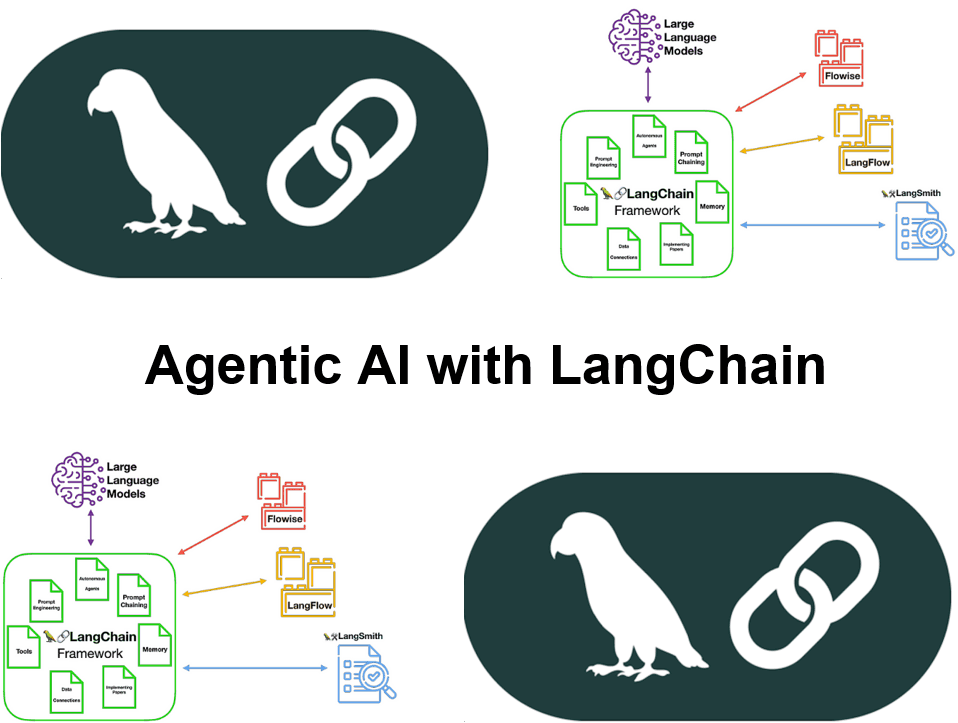
This module provides a thorough foundation in the LangChain framework, covering its architecture, the distinction between chains and agents, and essential components like prompt templates, memory modules, and document loaders.
Here participants create their first functional AI agent from scratch. The module covers choosing appropriate LLMs, defining clear agent goals, writing effective prompts, integrating tools, managing state, and implementing robust error handling.
This part focuses on expanding agent capabilities through tools and actions. Participants learn to create custom tools, integrate APIs, connect to databases, implement search functionality, enable web scraping, and handle tool execution errors properly.
Memory management is explored in depth, covering different memory types including short-term, long-term, conversation buffers, and vector stores. The module addresses entity memory, knowledge graphs, and techniques for optimizing memory.
This module introduces collaborative multi-agent systems using frameworks like LangGraph. Topics include agent collaboration patterns, message passing between agents, task decomposition, workflow orchestration, and evaluating multi-agent performance.
Retrieval Augmented Generation is covered comprehensively, including document processing, embeddings, vector databases, and semantic search. Participants learn chunking strategies, and methods for evaluating RAG system performance.
Deployment considerations are addressed with attention to API development, scalability, performance optimization, caching, rate limiting, and security best practices. The module also covers monitoring, observability, cost management, and testing strategies.
This course is intended for software developers, data scientists and AI engineers, who want to build autonomous AI systems using LangChain.
Participants should know Python programming and a basic understanding of machine learning.
The training combines theoretical instruction with hands-on exercises guided by an experienced trainer. Participants build working agents throughout the course.
After successful completion, participants receive a certificate of participation in Agentic AI with LangChain.
Module 1: Introduction to Agentic AI |
Module 2: LangChain Fundamentals |
Module 3: Building First Agent |
|
What is Agentic AI Agents vs Chatbots Agent Architecture Patterns LLMs as Reasoning Engines Agent Core Components Autonomy and Decision-Making Agent Frameworks Overview LangChain Introduction Use Cases and Applications Common Challenges |
LangChain Architecture Models and Prompts Chains vs Agents Prompt Templates Memory Modules Document Loaders Output Parsers Streaming Responses Tool Integration Basics LangSmith Debugging |
Choosing an LLM Defining Agent Goals Writing Effective Prompts Tool Selection and Integration Managing Agent State Error Handling Strategies Multi-Step Task Planning Agent Personality Design Logging and Monitoring Sandbox Environments |
Module 4: Agent Tools and Actions |
Module 5: Memory and Context |
Module 6: Multi-Agent Systems |
|
Tool Abstractions Custom Tool Creation API Integration Search Tools Calculator and Math Tools Database Connections File System Access Web Scraping Tools Code Execution Tools Tool Error Handling |
Memory Types Overview Short-Term Memory Long-Term Memory Conversation Buffer Vector Store Memory Entity Memory Knowledge Graphs Memory Retrieval Strategies Context Window Management Memory Optimization |
Multi-Agent Concepts Agent Collaboration Patterns LangGraph Framework Agent Roles and Responsibilities Message Passing Task Decomposition Goal Refinement Workflow Orchestration Conflict Resolution Evaluation Strategies |
Module 7: RAG and Knowledge |
Module 8: Production Deployment |
Module 9: Advanced Applications |
|
Retrieval Augmented Generation Document Processing Embeddings and Vectors Vector Databases Semantic Search Chunking Strategies Hybrid Search Reranking Techniques Citation and Sources RAG Evaluation |
Agent Deployment Patterns API Development Scalability Considerations Performance Optimization Caching Strategies Rate Limiting Security Best Practices Monitoring and Observability Cost Management Testing Strategies |
Coding Assistants Research Agents Customer Service Bots Finance and Analytics Agents Enterprise Automation Real-Time Agent Systems Guardrails and Safety Ethical Considerations Future of Agentic AI Capstone Project |
These companies already made use of our courses:
These companies used our courses: